

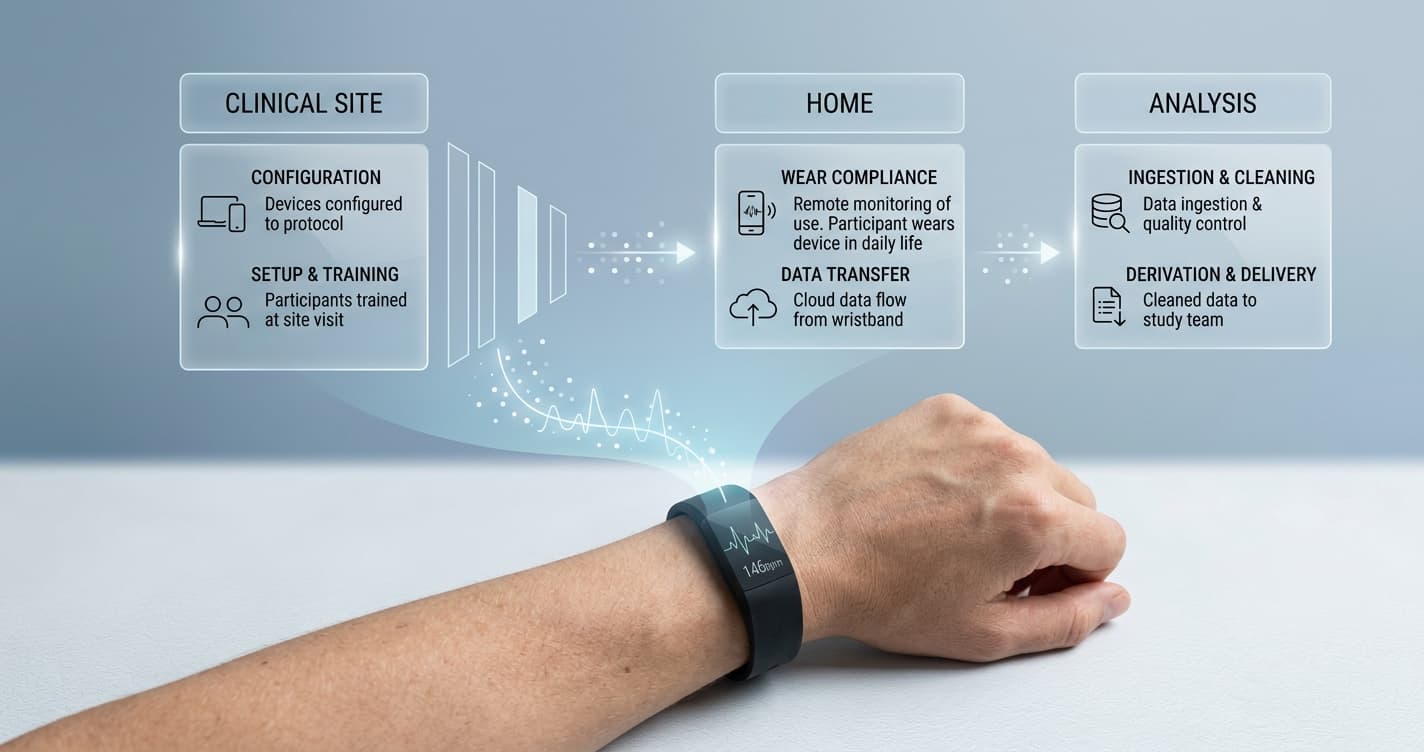
Decentralized clinical trials move some or all trial activity out of the research site and closer to where participants live. A visit happens by video. A local health care provider performs a physical examination. A wearable sensor records activity and sleep at home for weeks.
That shift can make a study easier to join and easier to stay in. It also moves measurement into an environment nobody on the study team controls. When a wearable provides trial data, the questions change: who ships the device, who trains the site, who notices when a participant stops wearing it, and who turns the data into something statisticians can use.
What Is a Decentralized Clinical Trial?
A decentralized clinical trial (DCT) is a trial in which some or all trial-related activities take place outside a traditional clinical trial site. The U.S. Food and Drug Administration (FDA) describes it as “a clinical trial that includes decentralized elements where trial-related activities occur at locations other than traditional clinical trial sites.”
FDA gives examples of decentralized elements, including “telehealth visits with trial personnel, in-home visits with remote trial personnel, or visits with local health care providers.”
Remote clinical trial is a term often used for the same model. FDA’s framing focuses on elements rather than labels: the guidance describes trials in which some or all trial-related activities happen away from traditional sites.
Fully Decentralized vs Hybrid Clinical Trials
A fully decentralized trial runs all trial activities away from traditional sites. A hybrid clinical trial combines site visits with decentralized elements. Many trials described as DCTs are hybrid.
FDA treats the choice as a design decision tied to the investigational product and the assessments. Its guidance says trials where all activities are decentralized “may be appropriate for investigational products (IPs) that have well-characterized safety profiles” and that do not require complex preparation, administration or medical assessments. It also describes cases where product administration or a complex medical assessment happens at a site while some follow-up assessments are performed remotely.
Hybrid designs let a sponsor keep in-clinic assessments where they are needed and move everyday measurement home. Wearable sensors usually sit on the home side of that split.
What Are the Benefits of Decentralized Clinical Trials?
FDA describes the benefits as potential, not guaranteed. Its guidance says DCTs “may enhance convenience for trial participants, reduce the burden on caregivers, and facilitate research on rare diseases and diseases affecting populations with limited mobility or limited access to traditional clinical trial sites.”
Each decentralized element also adds a handoff: a courier, a local provider, a technology vendor, a participant managing a device alone. Those handoffs are where data quality tends to slip.
Wearable sensors add something different from the other elements. They measure in daily life rather than at a single visit, so a sensor worn at home can record how a participant moves or sleeps across ordinary days. Whether that recording becomes useful trial evidence depends on the concept it measures and the evidence behind the measure. The difference between the measurement and the outcome built from it is set out in digital biomarkers vs digital endpoints.
Which Trial Activities Can Be Decentralized Under FDA Guidance?
FDA’s September 2024 guidance does not give a fixed list. It sets out principles for deciding which activities can move away from the site and who can perform them.
Remote Visits and Local Health Care Providers
Telehealth visits and in-home visits by trial personnel can replace some site visits. FDA says telehealth visits should comply with the laws governing telehealth in the relevant U.S. states, territories and other countries.
Local health care providers can take on activities they already perform in clinical practice, such as physical examinations, when those tasks do not require detailed knowledge of the protocol, the investigator’s brochure or the investigational product. FDA says activities unique to the research, or that require that knowledge, should be performed by trial personnel trained on the protocol.
Investigational Products Shipped to Participants
FDA says drugs “with good stability profiles” are best suited to direct shipment to a participant’s home. Products that need specialized handling, shipping or storage may not be. Products with a high-risk safety profile, or in early development with an undefined safety profile, may need in-person supervision by the investigator at a traditional site.
Digital Health Technologies
Digital health technologies (DHTs), including wearable sensors, can collect data remotely from participants. FDA guidance says DHTs used in a DCT should be available and suitable for all trial participants. Where a trial lets participants use their own DHTs, it says sponsor-provided DHTs should be available as an option, so participants without a protocol-specified DHT are not excluded for that reason.
Consent, Safety Monitoring and Electronic Systems
The guidance also covers informed consent and institutional review board oversight, safety monitoring, and the electronic systems used to run a DCT. It says training should be provided to all parties using those systems, including trial personnel, local health care providers, and trial participants.
What Does FDA Guidance Say About Digital Health Technologies in Decentralized Trials?
Two FDA guidances apply most directly. Both contain nonbinding recommendations, and neither tells a sponsor which device to use.
Conducting Clinical Trials With Decentralized Elements
FDA finalized Conducting Clinical Trials With Decentralized Elements in September 2024. Its recommendations cover DCT design and conduct, remote trial visits and trial-related activities, digital health technologies, the roles and responsibilities of sponsors and investigators, FDA oversight, informed consent and institutional review board oversight, investigational products in a DCT, packaging and shipping of investigational products, safety monitoring, and electronic systems used to conduct DCTs.
For the detail on DHTs, it points to FDA’s separate guidance on remote data acquisition.
Digital Health Technologies for Remote Data Acquisition in Clinical Investigations
FDA finalized this guidance in December 2023. The Federal Register notice for the DHT guidance lists its scope: the selection of DHTs suitable for clinical investigations, their description in regulatory submissions, verification and validation, their use to collect data for trial endpoints, managing risks associated with their use, retention and protection of the data they collect, and the roles of sponsors and investigators. The notice states that the guidance “is not binding on FDA or the public.”
A central idea is that a DHT should be fit for purpose, which FDA describes as “the level of validation associated with the DHT is sufficient to support its use, including the interpretability of its data in the clinical investigation.”
How Does Wearable Data Travel From a Participant’s Home to Analysis?
Wearable data passes through several hands between the participant and the analysis dataset. Each step needs a named owner.
- Configuration and assignment. Each device is set to the protocol’s settings and linked to a participant.
- Delivery and setup. The device reaches the site or the participant, and site staff or the participant complete setup and training.
- Wear and data transfer. The participant wears the device, and data moves to a platform on a defined schedule.
- Monitoring. The team checks that devices reach sites, reach participants and are worn as the protocol requires, and follows up on gaps while data can still be recovered.
- Ingestion and cleaning. Data from every sensor and device is ingested, checked and cleaned.
- Derivation. Defined algorithms convert cleaned data into the measures specified in the protocol.
- Delivery. Formatted data packages go to the study team for analysis.
FDA’s DCT guidance asks sponsors to write this down. It says a data management plan or other trial documents should include, at a minimum, data origin and data flow from all sources to the sponsor, the methods and technologies used for remote data acquisition, and a list of service providers for data collection, handling and management. Assigning those responsibilities across the sponsor, CRO, sites and technology partners is its own planning task, covered in who is responsible for wearable data in a clinical trial.
Where Wearable Data Breaks Down in Decentralized Trials
Wearable data is often lost in the gaps between the people responsible for the study, not only when a sensor stops working.
Device Logistics
Devices have to reach sites or participants configured, charged and assigned correctly. Replacements have to reach them when something fails. A shipping delay at the start of a study can mean missing baseline data that cannot be recovered.
Site Training
Participants usually turn to site staff for help. If site staff do not know how the device works, how it should be worn or what to do when it stops syncing, participants get inconsistent answers.
Wear Compliance
A device in a drawer produces no data. Participants remove devices to charge them, forget to put them back on or stop wearing them when a study runs long. Without active monitoring, the team often finds out at analysis. How wear time turns into usable days of data is explained in wear time, valid days and analyzable data.
Data Gaps
Syncing failures, firmware changes and partial days all create gaps. Some can be recovered if they are caught quickly. Most cannot be recovered months later.
Unclear Ownership
The sponsor’s contract research organization (CRO) manages the trial. The device manufacturer supports the hardware. When a wearable stops sending data, it is often not clear whose job it is to fix it.
FDA’s guidance addresses coordination in general terms. It notes that DCTs may involve many contracted services and says sponsors should coordinate decentralized elements properly. It also says investigators should follow up on data that are missing, concerning or appear to be in error.
What Should Sponsors Consider for Participants and Sites?
Participants and site staff carry most of the daily work of a decentralized wearable study. A design that looks sound on paper can fail if either group cannot sustain it.
Participant Considerations
- Comfort and wear location, over weeks rather than hours
- Ease of use, including how the device is put on and taken off
- Battery life and a charging routine that fits daily life
- Clear instructions on what to do when the device stops working
- Who the participant contacts, and how quickly they hear back
Guidance on weighing these factors during device choice is in how to select wearable sensors for a clinical trial. Some studies also decide whether to return wearable data to participants, which raises its own questions about what to share and how. VivoSense has written about sharing wearable sensor data with participants.
Site Considerations
- Training on device setup, wear and troubleshooting before enrollment opens
- The same instructions and materials at every site, across countries and languages
- A defined path for device replacement and return
- Clarity on which questions the site answers and which go to the technology partner
When Is a Decentralized Element a Poor Fit?
Not every activity or measure belongs at home. A decentralized element is a poor fit when moving it away from the site adds risk without adding usable evidence.
- The investigational product needs supervision. FDA’s guidance says products with a high-risk or poorly defined safety profile, or that need complex preparation or administration, may need in-person supervision at a site.
- The assessment needs protocol-trained staff. Activities unique to the research belong with trained trial personnel, not local providers.
- The digital measure lacks evidence for the population. A measure without verification and validation evidence for the intended population and context of use carries that gap into the trial. The evidence components are covered in digital measure validation and the V3 framework.
- The wear burden is unrealistic. A wear or charging schedule the population cannot sustain produces missing data.
- Nobody owns monitoring. Without a named owner for follow-up, gaps surface at analysis.
In these cases, a hybrid design can keep the assessment at the site while other activities move home.
How to Plan the Digital Measurement Workstream
Planning starts with the clinical question, then moves through operations.
Start With the Concept of Interest
Define what the trial needs to measure and why it matters to patients. The measure and the technology follow from that concept, not the other way around.
Choose the Right Device for the Population
Select technology based on the disease state and the patient population. A device that works well for healthy adults may not suit participants with mobility limitations, respiratory disease or disrupted sleep.
Choose What Measures to Capture
Decide which measures will be derived from the device data and how each will support the trial’s objectives.
Establish Validation Evidence
Plan the evidence each measure needs for its role in the trial and its context of use.
Operationalize Devices and Sites
Plan device shipping, site training and replacement processes before enrollment opens.
Monitor Wear Compliance in Real Time
Track whether devices reach sites, reach participants and are being worn as the protocol requires. Real-time monitoring can help teams act sooner.
Clean, Analyze and Deliver the Data
Ingest data from every sensor and device, clean it and run it through defined algorithms to produce data packages the study team can use.
A Planning Checklist for Decentralized Trials With Wearable Sensors
- Define the concept of interest and the role of each digital measure.
- The protocol specifies which visits happen at sites, which happen remotely and which are left to participant choice, as FDA’s guidance recommends.
- The device is selected for the disease state and the patient population.
- Evidence for each measure in the intended population and context of use is identified, with gaps planned for.
- The wear protocol states wear location, wear duration, charging routine and what counts as a usable day.
- Device shipping, replacement and return are planned.
- Training materials exist for sites and participants.
- The monitoring plan defines when a gap triggers follow-up and who acts.
- The data management plan records data origin, data flow and every service provider.
- Every handoff between sponsor, CRO, sites, device manufacturer and measurement partner has a named owner.
Decentralized Trials With VivoSense
VivoSense is a wearable sensor CRO. It works alongside the sponsor’s trial team and CRO on the digital measurement workstream, rather than replacing either.
VivoSense helps sponsors choose the right device based on the disease state and the population of the patients, choose what measures to capture, ship devices and train sites, and monitor real-time wear compliance through a purpose-built cloud platform. It then ingests the data, including from multiple sensors and devices, cleans it and delivers formatted regulatory-ready data packages for the study team. The service areas are described on the VivoSense solutions page.
In a cystic fibrosis study described in an April 2025 case study, VivoSense managed sensor-based DHTs monitoring physical activity, sleep patterns and cough frequency across 200 devices at 18 sites worldwide, reporting “99% data availability” and “94% wear compliance.” The details are in the cystic fibrosis case study.
VivoSense was founded in 2010.
Frequently Asked Questions
What are decentralized clinical trials?
Clinical trials that include decentralized elements, where trial-related activities happen at locations other than traditional clinical trial sites. Examples include telehealth visits, in-home visits, visits with local health care providers and data collection through digital health technologies.
What is the difference between a decentralized trial and a hybrid trial?
A fully decentralized trial runs without traditional site visits. A hybrid trial combines site visits with decentralized elements. Many trials described as DCTs are hybrid.
Does FDA have guidance on decentralized clinical trials?
Yes. FDA finalized “Conducting Clinical Trials With Decentralized Elements” in September 2024 and “Digital Health Technologies for Remote Data Acquisition in Clinical Investigations” in December 2023. Both contain nonbinding recommendations.
What are the benefits of decentralized clinical trials?
FDA says DCTs may enhance convenience for participants, reduce the burden on caregivers, and facilitate research in rare diseases and in populations with limited mobility or limited access to trial sites. Those benefits depend on how well each decentralized element is planned and run.
Is a remote clinical trial the same as a decentralized clinical trial?
The terms are often used for the same model. FDA uses “decentralized elements” to describe activities that happen away from traditional sites, whether a trial moves some activities or all of them.
How are wearable sensors used in decentralized trials?
Wearable sensors collect data such as physical activity, sleep and cough frequency while participants go about daily life. That data can support trial measures without a site visit for each assessment, provided the measure has evidence for its context of use.
Can participants use their own devices in a decentralized trial?
FDA’s DCT guidance addresses trials that let participants use their own DHTs. It says sponsor-provided DHTs should be available as an option, so participants without a protocol-specified DHT are not excluded for that reason.
What causes missing wearable data in decentralized trials?
Common causes include devices removed for charging and not replaced, syncing failures, slow follow-up with participants and unclear responsibility between the CRO and the device manufacturer.
Does a wearable sensor CRO replace the trial’s CRO?
No. A wearable sensor CRO often works alongside existing trial partners and covers the digital measurement workstream, while the primary CRO continues to manage the trial.
Let’s Talk
Schedule a consultation to explore how to design and use validated digital measures in your clinical trials.
Book A Meeting