

A study dashboard shows participants wearing their devices most of the time. Months later, the statisticians report that a large share of days cannot be used.
Both reports can be accurate. They are measuring different things.
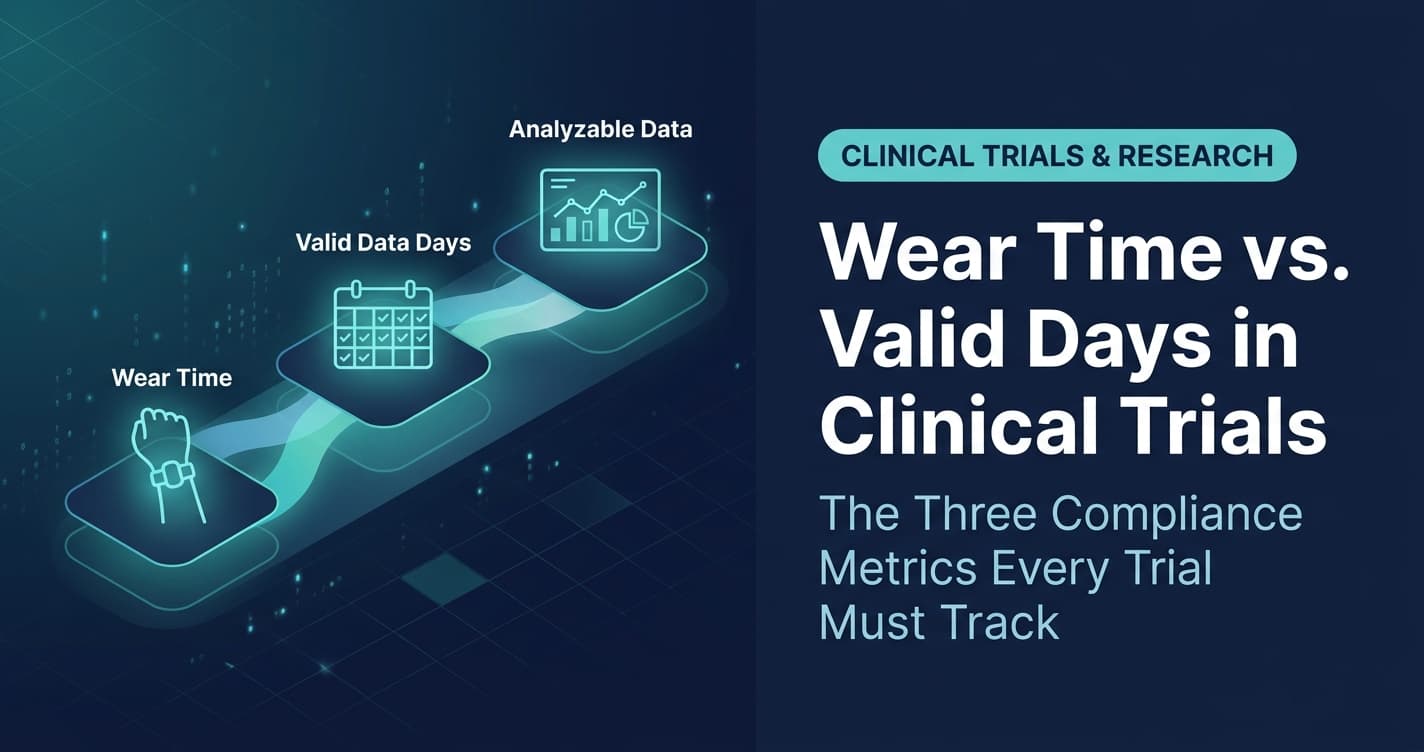
In a trial that uses wearable sensors, it helps to track three separate numbers related to compliance: wear time, valid data days and analyzable data. Each one answers a different question, and only the last two decide whether a digital measure can support the analysis the protocol promised.
What Is Wear Time?
Wear time is how long a device was on the participant’s body. It is usually reported as hours per day or as a percentage of the expected wear period.
Wear time is easy to misread. A device can be on the body and still produce data that does not count toward the measure the trial needs.
What Counts as a Valid Data Day?
A valid data day is a day that meets the rules a protocol sets for inclusion in analysis. Those rules usually specify a minimum number of hours of wear, and often when those hours must fall.
A sleep measure needs overnight wear. A daytime physical activity measure needs enough waking hours. A participant who wears a device all day but removes it every night contributes very little to a sleep measure.
Valid day rules should be set before the study starts, and they should reflect the concept of interest the measure is meant to capture. A 2017 systematic review of accelerometer data collection and processing criteria in Sports Medicine lists non-wear time and what constitutes a valid day among the criteria that accelerometer studies set.
What Is Analyzable Data?
Analyzable data is what remains after quality checks. Data from a valid day can still be lost to artifact, sensor malfunction, syncing errors or processing failures. Methods for testing, reporting and handling missing data belong in a data quality system for digital biomarker development, defined before data collection begins.
Analyzable data is the number the statistical plan depends on. If it falls short, the study may not have the data it was designed around.
Why Can Wear Time Look Healthy While Valid Days Fall?
| Metric | What it measures | What it can hide |
|---|---|---|
| Wear time | Hours the device was on the body | Wear at the wrong times of day, short partial days |
| Valid data days | Days meeting the protocol’s inclusion rules | Days that qualify on hours but fail quality checks |
| Analyzable data | Data that survives quality review | Nothing further: this is what the analysis uses |
The gap between wear time and analyzable data is where studies lose data quietly. A team that watches only wear time may not see the problem until analysis, when it is often too late to fix.
Where Valid Days Get Lost
Charging and Removal
Participants take devices off to charge them, shower or sleep more comfortably. If the device does not go back on, the rest of the day may not qualify.
Syncing Failures
A device can record data that never reaches the study database. The longer a syncing problem goes unnoticed, the more data is at risk.
Slow Follow-Up With Sites
When a participant’s data stops arriving, someone has to contact the site and the site has to contact the participant. Every day of delay is another day of missing data.
Processing Rules Built for a Different Population
Algorithms built on data from healthy adults may misclassify wear or activity in patient populations. Participants with limited mobility, for example, can look like they are not wearing a device when they are. The validation evidence behind a digital measure has to fit the population the trial enrolls.
What Operational Oversight Looks Like
Compliance does not manage itself. It needs someone watching the data while the study is running.
VivoSense uses a purpose-built cloud platform that monitors a device getting to site, the device getting onto the patient and real-time wear compliance, to check that patients are wearing devices as the protocol requires. That monitoring sits alongside training sites on how to use the devices.
What Published Studies Show
In an argenx case study published in July 2025 and presented at the 2025 Digital Biomarkers Summit, VivoSense reported a 95.3% rate of valid data days in a Phase 3b open-label study. The same case study reports that a previous Phase 2 study achieved a 54.82% rate of valid data days when VivoSense operational oversight was not included. Read the argenx wearable sensor CRO partnership case study.
In a global cystic fibrosis study described in an April 2025 case study, VivoSense deployed sensor-based digital health technologies to monitor physical activity, sleep and cough across 200 devices at 18 sites worldwide. The study reported “99% data availability” and “94% wear compliance.” Read the cystic fibrosis data quality case study.
How to Plan for Valid Days Before a Study Starts
Define Valid Day Rules Prospectively
Write the inclusion rules into the protocol or statistical analysis plan. Base them on the concept of interest and on the digital biomarker the endpoint depends on.
Match Wear Requirements to the Measure
If the endpoint is about sleep, plan for overnight wear. If it is about daytime activity, plan for waking hours. Tell participants why.
Plan Monitoring and Escalation Before Enrollment
Decide who reviews compliance data, how often, and who contacts sites when data stops arriving. The U.S. Food and Drug Administration (FDA) final guidance on digital health technologies (DHTs) for remote data acquisition, issued in December 2023, recommends that sponsors have a plan to reduce the potential for missing data, with examples such as automated data monitoring and alerts, participant reminders and investigator outreach to participants.
Name who is responsible for wearable data in the trial in the contract. The same planning applies to decentralized clinical trials that use wearable sensor data, where more of the data collection happens away from sites.
Choose Devices Participants Can Live With
Battery life, comfort and wear location affect how long participants keep a device on, which makes participant experience part of selecting wearable sensors for a clinical trial. The right device depends on the disease state and the population of the patients.
Report All Three Numbers
Track wear time, valid data days and analyzable data separately. Reporting only the first gives a false sense of security.
Common Mistakes
Treating Wear Time as the Compliance Number
Wear time describes the device. Valid data days and analyzable data describe the dataset.
Setting Valid Day Rules After Data Collection
Rules chosen after seeing the data invite questions about bias and leave no time to fix collection problems.
Waiting Until Analysis to Review Data Quality
Collection problems found at the end of a study cannot be corrected. Problems found in the first week often can.
Compliance Monitoring With VivoSense
VivoSense is a wearable sensor contract research organization (CRO) that works alongside the sponsor’s trial team and CRO on the digital measurement workstream. It helps choose the right device for the disease state and patient population, ships devices and trains sites, monitors real-time wear compliance, and cleans and analyzes the data into formatted regulatory-ready data packages for the study team.
VivoSense was founded in 2010.
Frequently Asked Questions
What is wear time in a wearable clinical trial?
Wear time is how long a participant wore the device, usually reported as hours per day or a percentage of the expected wear period.
What is a valid data day?
A day that meets the protocol’s rules for inclusion in analysis, usually a minimum number of wear hours in a defined window.
Why is wear time not enough to measure compliance?
A device can be worn at the wrong times or for too few hours. Those days can count toward wear time but not toward valid data days or analyzable data.
How can sponsors reduce missing wearable data?
Set valid day rules before the study, choose devices suited to the population, monitor compliance while the study runs and act quickly when data stops arriving.
When should valid day rules be defined?
Before data collection begins, in the protocol or statistical analysis plan, based on the concept of interest the measure is meant to capture.
Let’s Talk
Schedule a consultation to explore designing and using validated digital measures in your clinical trials.
Book A Meeting