

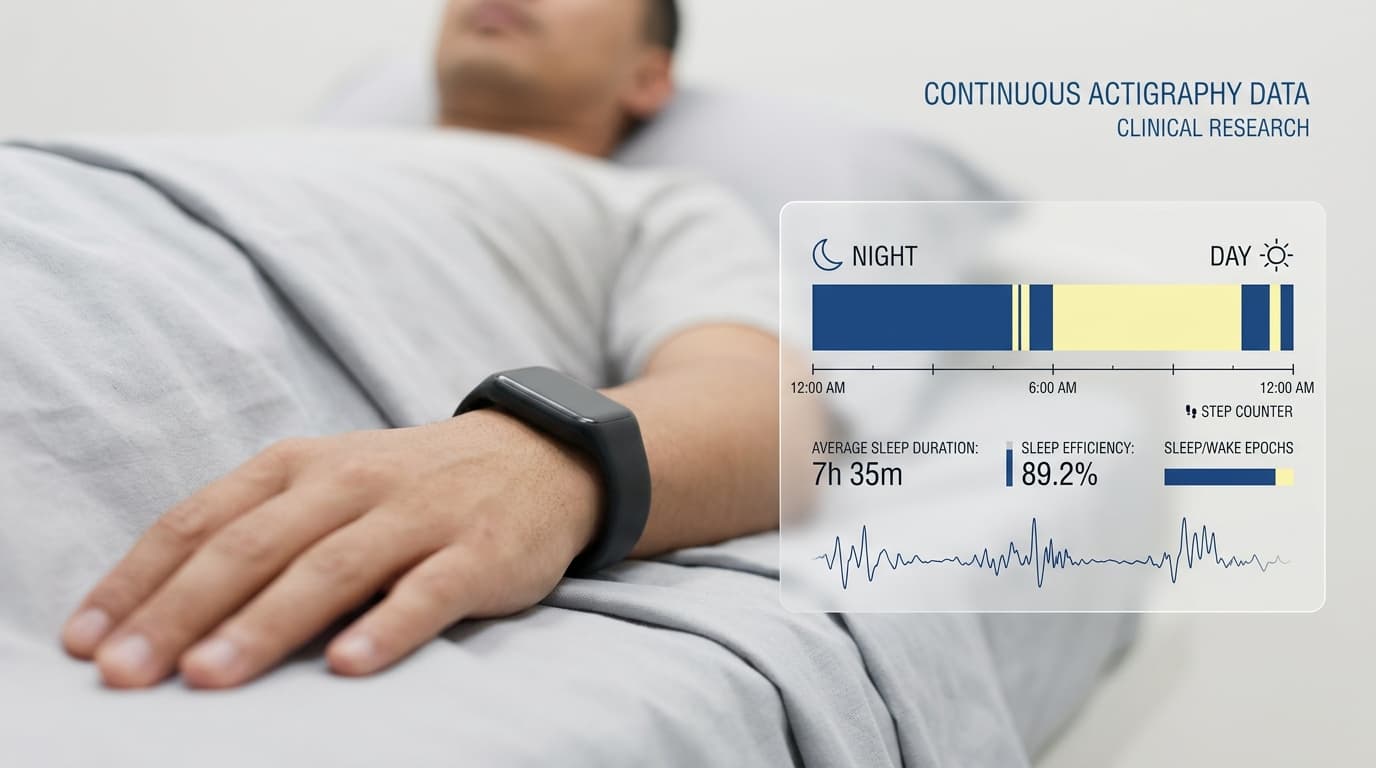
Researchers have used actigraphy in sleep and activity research for decades. A small device, usually worn on the wrist, records movement continuously for days or weeks. Algorithms turn that movement into estimates of sleep and activity.
It is simple to deploy, which makes its design choices easy to overlook. The same data can produce different results depending on the algorithm, the wear rules and the population being studied. For a clinical trial, those choices decide whether an actigraphy measure holds up.
What Is Actigraphy?
Actigraphy uses an accelerometer, a sensor that detects movement, to record activity over time. The American Academy of Sleep Medicine (AASM) describes it as a procedure that records and integrates the occurrence and degree of limb movement over time, with devices worn on the wrist, ankle, or waist over a period of days to weeks. Mathematical algorithms are then applied to the data to estimate sleep and wakefulness.
Because the device is small and doesn’t require a technician, participants can wear it at home during normal life. That makes actigraphy suitable for measuring patterns across many days and nights rather than a single session.
What Is Wrist Actigraphy?
Wrist actigraphy is actigraphy recorded from a device worn on the wrist. It is the most common approach. The SBSM Guide to Actigraphy Monitoring, published in Behavioral Sleep Medicine in 2015, states that in adults the nondominant wrist remains the best-validated placement.
Other placements capture different movement. An overview of wearable sensor types and wear location covers how placement relates to the signal being measured.
What Does Actigraphy Measure?
Actigraphy does not measure sleep directly. It measures movement, and algorithms estimate sleep and wake from patterns of movement and stillness. The same recording can also describe daytime physical activity and the timing of rest and activity across the 24-hour day.
Sleep Measures
The AASM guideline compared actigraphy with sleep logs and polysomnography for four sleep parameters:
- Total sleep time: time asleep during the main sleep period
- Sleep latency: how long it takes to fall asleep after a recorded bedtime
- Wake after sleep onset: time awake after first falling asleep
- Sleep efficiency: the proportion of time in bed spent asleep
For circadian rhythm sleep-wake disorders, the guideline also compared sleep onset and sleep offset times, the clock times at which sleep begins and ends. The SBSM guide adds the frequency and duration of night waking.
Sleep latency and sleep efficiency depend on knowing when the participant went to bed and got up. The SBSM guide states that supplemental information is always required to obtain those two measures, which is why diaries and event markers matter.
Rest-Activity Patterns
Some actigraphy software also describes circadian, or 24-hour, activity patterns independent of sleep and wake scoring. The SBSM guide lists parameters such as acrophase (the timing of the activity peak), amplitude (the height of the peak), and mesor (the midpoint of the rhythm). The AASM guideline notes that actigraphy can establish habitual sleep-wake timing.
Physical Activity Measures
The same accelerometer data can be used to derive physical activity measures, including:
- Step count
- Time spent active
- Patterns of activity across the day
Physical activity measurement from actigraphy depends on the same choices as sleep: placement, processing, and an algorithm suited to the population.
What Is an Actigraphy Sleep Study?
An actigraphy sleep study records movement over consecutive days and nights, usually at home, to estimate sleep and wake patterns. It is often paired with a sleep diary.
In clinical practice, the AASM guideline recommends a minimum recording duration of 72 hours to 14 consecutive days, in line with procedural coding requirements. The SBSM guide notes that 7 to 14 days are more likely to provide adequate information because capturing both weekday and weekend sleep helps, and that a 14-day recording spanning two weekends is preferred for circadian assessment. A trial sets its own recording window in the protocol, based on the measure and the population.
Do Sleep Diaries Still Matter Alongside Actigraphy?
Yes. A sleep diary records what the participant reports: bedtime, when they tried to fall asleep, wake time, and when they got out of bed. The SBSM guide recommends a separate actigraphy log if the diary does not collect those times. Pressing an event marker on the device adds a time stamp that assists scoring.
Diaries and actigraphy are not interchangeable. In meta-analyses reported in the AASM guideline, actigraphy and sleep logs showed clinically significant large mean differences for total sleep time, sleep latency, and sleep efficiency. The two methods give different information, and a protocol should state which one each measure relies on.
How Does Actigraphy Compare With Polysomnography?
Polysomnography (PSG) records brain activity, eye movement, muscle activity, breathing, blood oxygen, and heart rhythm, usually overnight in a sleep laboratory. It identifies sleep stages and helps diagnose sleep disorders.
Actigraphy is less detailed. It cannot identify sleep stages the way PSG can. Its strength is duration and setting: it can capture sleep and activity patterns over weeks, at home, with far less burden on participants. VivoSense has written about using wearable sensors to assess sleep-related outcome measures outside the laboratory.
The AASM’s 2018 clinical practice guideline on actigraphy, published in the Journal of Clinical Sleep Medicine, made conditional recommendations for using actigraphy to assess insomnia disorder and circadian rhythm sleep-wake disorders in adults and children, and to estimate total sleep time in several other clinical situations. It strongly recommended against using actigraphy in place of electromyography to diagnose periodic limb movement disorder. The guideline was written for clinical evaluation. A trial still has to set out evidence for its own measure, population and context of use.
| Actigraphy | Polysomnography | |
|---|---|---|
| What it records | Movement | Brain activity, eye movement, muscle activity, breathing, blood oxygen, heart rhythm |
| Setting | Home, daily life | Usually a sleep laboratory |
| Duration | Days to weeks | Usually one or a few nights |
| Sleep stages | Not identified | Identified |
| Participant burden | Low | Higher |
Why Algorithm Choice Matters
Algorithm choice matters because the same movement data can be scored differently depending on the population, wear location, epoch settings, and processing.
Population
Sleep and activity algorithms are often developed in healthy adults. People with conditions that affect movement, pain or sleep may be misclassified. A person lying still but awake can be scored as asleep. A person with limited mobility may register little activity even when active.
As VivoSense’s guide to selecting wearable sensors for a clinical trial puts it: “Validation should always be evaluated within the intended context of use. A wearable sensor validated for healthy adults may not perform similarly in patients with neurological disorders, respiratory disease, or mobility limitations.”
Wear Location
Wrist, waist and ankle placements capture different movement. An algorithm developed for one placement may not transfer to another.
Epochs and Scoring Rules
Actigraphy data are stored in short time blocks called epochs. The SBSM guide states that the system must record data in 30-second or 1-minute epochs, and that the scoring algorithm should be specified first and validated for the specific device and population. Some software lets you adjust the threshold that separates sleep from wake.
Each of those settings changes the output. The protocol or statistical analysis plan should fix the epoch length, algorithm, and threshold before data collection, and keep them constant for the whole study.
Processing Raw Data
How raw accelerometer data is filtered, summarized and scored affects every downstream measure. Two studies using the same device can report different sleep efficiency if they process the data differently.
Defining a Valid Night and a Valid Day
Actigraphy measures depend on enough usable data. A protocol should define, before the study starts, how many hours of wear make a valid day or night, and when those hours must fall.
A sleep measure needs overnight wear. A daytime activity measure needs enough waking hours. Wear time alone does not tell a team whether the data will support the analysis. See wear time, valid days and analyzable data.
From Actigraphy Data to a Trial Endpoint
Turning actigraphy data into an endpoint can follow the five stages used to develop digital endpoints:
- Identify a Meaningful Clinical Concept: decide what aspect of sleep or activity matters to patients in this condition.
- Select Appropriate Technologies: choose a device and wear location suited to the concept and the population.
- Develop Digital Biomarkers: define the algorithm and scoring rules.
- Establish Validation Evidence: gather analytical and clinical evidence for the population and context of use.
- Build Digital Endpoints: set the analysis, time points and role in the trial.
A sleep efficiency value is a digital biomarker. The trial outcome built from it is the endpoint. What are digital biomarkers and digital biomarkers vs digital endpoints set out the difference.
For validation, the U.S. Food and Drug Administration (FDA) final guidance on digital health technologies for remote data acquisition, announced in December 2023, provides nonbinding recommendations on verifying and validating digital health technologies (DHTs) and on using DHTs to collect data for trial endpoints. The evidence types are explained in digital measure validation and the V3 framework.
An Actigraphy Planning Checklist
- The sleep or activity concept that matters to patients
- Wear location and which wrist
- Recording window, including weekdays and weekends
- Epoch length, scoring algorithm and threshold, fixed in advance
- Evidence the algorithm performs in this population
- Sleep diary or log content, and event marker use
- Valid night and valid day rules
- How each measure feeds the analysis plan
Published Work
VivoSense has published and presented work relevant to actigraphy.
Step Count Analytical Validation
In February 2025, VivoSense published an analytical validation of wrist-worn accelerometer-based step count methods during structured and free-living activities, describing a validated step-counting method optimized for real-world performance. The methods were “tested across various walking speeds and daily activities.” That work addresses analytical validity in the studied conditions, not every population. Read the step count analytical validation summary.
Sleep Assessment for Short and Disrupted Sleep
In August 2024, VivoSense described work on developing novel patient-centric digital sleep assessment tools for people with short and disrupted sleep, presented at a workshop held by the FDA and the Digital Medicine Society (DiMe) titled “Using patient-generated health data in medical device development.” The page notes that “wrist actigraphy sensors offer the benefit of low patient burden and continuous monitoring” and discusses “sleep latency, duration, and efficiency.” Read about the sleep assessment work.
Common Mistakes
Using Default Algorithms Without Checking the Population
Defaults built on healthy adults may misclassify sleep and activity in patients.
Treating Actigraphy as a Replacement for Polysomnography
The two measure different things. Choose based on the question.
Treating Diary and Actigraphy Values as Interchangeable
Self-reported and movement-based sleep estimates can differ substantially. Mixing them across visits or participants makes results hard to interpret.
Changing Wear Location or Settings Mid-Study
Different placements, epoch lengths or thresholds produce different data. Consistency matters.
Setting Valid Day Rules After the Data Arrives
Rules chosen after seeing the data raise questions about bias and leave no time to fix collection problems.
Actigraphy With VivoSense
VivoSense is a wearable sensor contract research organization (CRO) that works alongside the sponsor’s trial team and CRO on the digital measurement workstream. It helps choose the right device based on the disease state and patient population, selects what measures to capture, ships devices and trains sites, monitors real-time wear compliance, and cleans and analyzes the data into formatted, regulatory-ready data packages for the study team.
VivoSense was founded in 2010.
Frequently Asked Questions
What is actigraphy?
A method of recording movement over time with an accelerometer, usually worn on the wrist. Algorithms use the movement data to estimate sleep and physical activity.
What is wrist actigraphy?
Actigraphy is recorded from a device worn on the wrist, the most common placement. The SBSM guide describes the nondominant wrist as the best-validated placement in adults.
What does actigraphy measure in sleep studies?
Actigraphy estimates total sleep time, sleep latency, wake after sleep onset, sleep efficiency and the timing of sleep onset and offset from patterns of movement and stillness.
What is an actigraphy sleep study?
A recording of movement over consecutive days and nights, usually at home, used to estimate sleep and wake patterns. It is often paired with a sleep diary.
How long is actigraphy worn?
The AASM guideline gives a clinical recording duration of at least 72 hours and up to 14 consecutive days. Trials define their own window in the protocol.
Is actigraphy as accurate as polysomnography?
They measure different things. Polysomnography records brain activity and identifies sleep stages. Actigraphy estimates sleep from movement and can do so over weeks at home.
How is actigraphy used in clinical trials?
To measure sleep and physical activity in participants’ daily lives over extended periods, supporting trial measures without requiring overnight laboratory visits.
Why does the actigraphy algorithm matter?
Different algorithms, epoch lengths, and thresholds can produce different results from the same data, and algorithms developed in healthy adults may not perform the same way in patient populations.
Let’s Talk
Schedule a consultation to explore how to design and use validated digital measures in your clinical trials.