

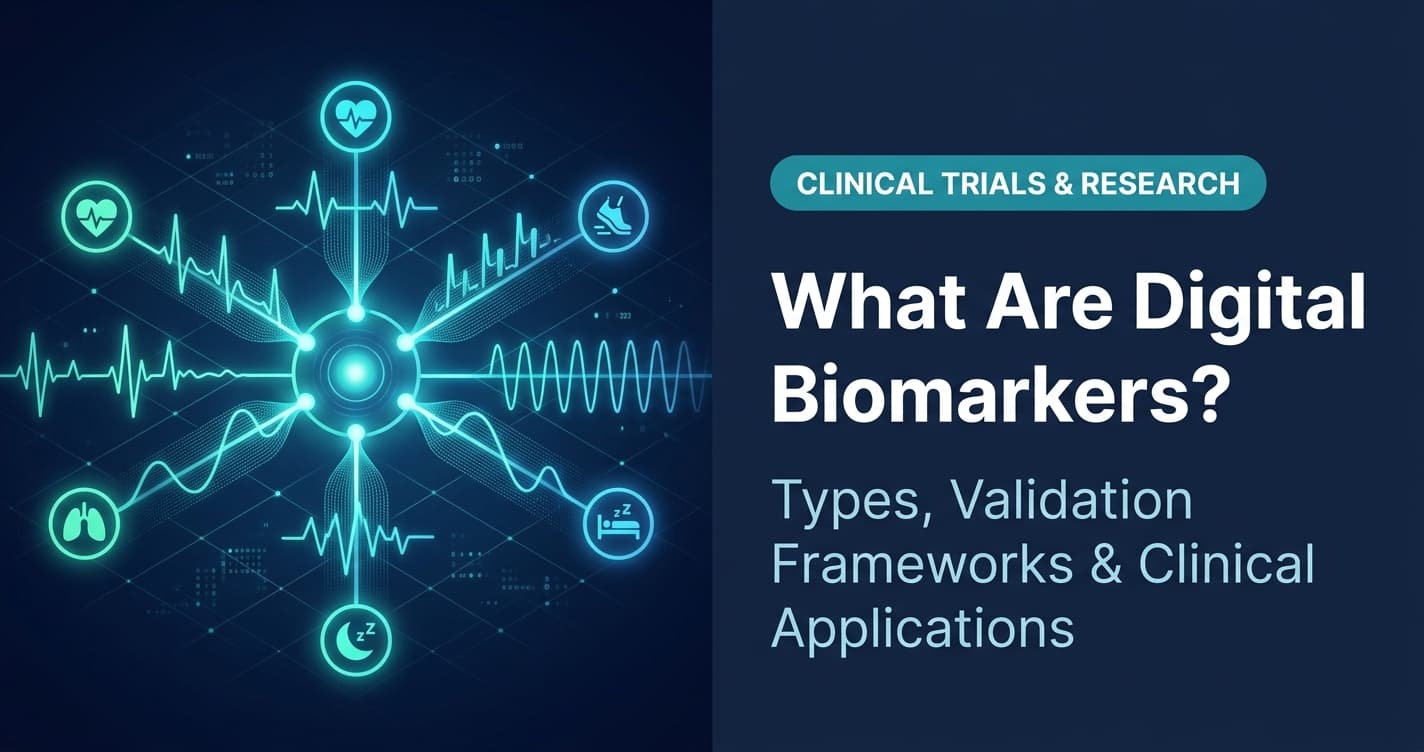
Clinical trials have long measured patients in snapshots. A clinic visit captures how someone walks, sleeps or breathes on one day, in one room, under observation. Digital biomarkers change what a trial can see between those visits.
The term gets used loosely. Sponsors hear it alongside digital endpoints, digital measures and clinical outcome assessments, often in the same meeting. Each term means something different, and the differences matter when a measure has to hold up in front of a biostatistics group or a regulator.
What Is a Digital Biomarker?
A digital biomarker is an objective, quantifiable physiological or behavioral measurement collected through a digital device. The device can be a wearable sensor, smartphone, or connected health technology.
Two parts of that definition do the work. The measurement is objective and quantifiable, so it does not depend on someone’s recall or a clinician’s impression. And it is collected through a device, often continuously and outside the clinic.
A raw sensor signal is not a digital biomarker on its own. An accelerometer records movement data many times per second. A step count, a walking cadence or a sleep duration derived from that data, using a defined method, is the measurement.
In clinical research, the device that collects the data is usually described as a digital health technology (DHT). The DHT captures the signal. The digital biomarker is the defined measurement produced from it.
What Can a Digital Biomarker Measure?
Digital biomarkers cover a wide range of physiological and behavioral characteristics. Each measurement domain is typically captured by a particular class of connected health technology.
| Measurement domain | Example measures | Typical technology class |
|---|---|---|
| Physical activity | Step count, time active | Activity monitors, smart watches |
| Gait and mobility | Walking cadence, real-world mobility | Activity monitors, biosensors |
| Sleep | Sleep latency, sleep duration, sleep efficiency | Activity monitors |
| Respiratory patterns | Breathing patterns, apnea events | Respiratory monitoring devices |
| Cough | Cough frequency | Respiratory monitoring devices, biosensors |
| Heart rate | Heart rate, heart rate variability | Cardiac sensors |
| Physical function | Measures of daily functional capacity | Activity monitors, biosensors |
| Fatigue and energy levels | Activity and rest patterns, as indirect indicators | Activity monitors |
The domain a sponsor chooses should follow from the clinical question, not from the device on hand.
What Are Examples of Digital Biomarkers?
Common examples of digital biomarkers include daily step count, walking cadence, sleep duration, sleep efficiency, cough frequency and heart rate variability. Each one is a defined measurement derived from sensor data collected in daily life.
- Daily step count reflects the volume of walking a participant does across a day.
- Walking cadence reflects the pace of walking, expressed as steps per minute.
- Sleep duration and sleep efficiency reflect how long a participant sleeps and how much of the time in bed is spent asleep.
- Cough frequency reflects how often a participant coughs over a defined period.
- Heart rate variability reflects variation in the time between heartbeats.
- Time active reflects how much of the day a participant spends moving above a defined threshold.
Several of these can come from the same raw data. A single wrist-worn accelerometer can support step count, cadence, activity time and sleep measures, each with its own algorithm and its own rules.
None of these examples is an endpoint by itself. Each becomes part of an endpoint only when a trial defines how it will be summarized, compared and analyzed.
How Are Digital Biomarkers Categorized?
Biomarkers are most often categorized by how they are used. The field’s reference framework is the Biomarkers, EndpointS, and other Tools (BEST) Resource from the U.S. Food and Drug Administration (FDA) and the National Institutes of Health (NIH).
The FDA-NIH BEST Resource glossary defines a biomarker as “a defined characteristic that is measured as an indicator of normal biological processes, pathogenic processes, or biological responses to an exposure or intervention, including therapeutic interventions.” It groups biomarkers by use into categories including:
- Susceptibility or risk biomarkers, which indicate the potential for developing a disease in someone who does not have it
- Diagnostic biomarkers, which confirm the presence of a disease or identify a subtype
- Monitoring biomarkers, which are measured repeatedly to assess the status of a disease or evidence of exposure to a medical product
- Prognostic biomarkers, which indicate the likelihood of a clinical event, recurrence or progression
- Predictive biomarkers, which identify individuals more likely to experience a favorable or unfavorable effect from a medical product
- Response biomarkers, which show that a biological response has occurred after exposure to a medical product
- Safety biomarkers, which indicate the likelihood, presence or extent of toxicity
The BEST glossary also states that “a biomarker is not a measure of how an individual feels, functions, or survives.” Measures of how a patient feels or functions are classed as clinical outcome assessments (COAs). The distinction is explained in clinical outcome assessments vs biomarkers vs endpoints.
VivoSense uses “digital biomarker” more broadly than the BEST biomarker definition, for any objective physiological or behavioral measurement collected through a digital device. That usage includes measures such as daily step count, which describe how a patient functions. Where the regulatory classification of a particular measure matters, it depends on what the measure captures and how the trial uses it.
FDA’s August 2026 paper, Key Considerations for the Development and Use of Digitally Derived Measures for Clinical Investigations, makes the same point. It states that “DDMs may be used as clinical outcome assessments (COAs), biomarkers, or as part of multicomponent endpoints derived from multimodal data,” where DDMs are digitally derived measures. The document is a paper that draws on existing FDA guidances. It is not guidance.
How Does a Digital Biomarker Differ From a Digital Endpoint?
A digital endpoint is a trial outcome measure that uses one or more digital biomarkers to assess treatment effects, disease progression, or other study objectives.
Put simply, digital biomarkers are the measurements, while digital endpoints are the outcomes derived from those measurements. One way to picture it: think of digital biomarkers as ingredients and digital endpoints as the finished product.
A daily step count is a digital biomarker. A change in average daily step count from baseline to week 24, analyzed under a prespecified statistical plan, is an endpoint. The same biomarker can feed several endpoints, and an endpoint can draw on more than one biomarker.
For a fuller comparison, see digital biomarkers vs. digital endpoints and why the difference matters for your trial.
How Is a Digital Biomarker Developed?
Development can be described in five stages. Each stage depends on the one before it.
Identify a Meaningful Clinical Concept
The first step is identifying a clinically meaningful concept of interest that matters to patients, clinicians, and regulators. This concept then guides biomarker selection, validation, and endpoint development.
A concept might be walking ability, sleep disruption or nighttime breathing patterns. The question is whether a change in that concept would matter to the people living with the condition.
Select Appropriate Technologies
With the concept defined, the team selects technology that can capture it in the target population. Wear location, battery life, participant burden and data access all shape the choice. See how to select wearable sensors for a clinical trial.
Develop Digital Biomarkers
Algorithms turn sensor data into a defined measurement. This stage sets the rules: what counts as a step, a night of sleep or a valid day of data.
Establish Validation Evidence
The measurement has to be shown to work. That means analytical evidence that it measures what it claims, and clinical evidence that it relates to something meaningful for patients.
Build Digital Endpoints
Finally, digital biomarkers with adequate validation evidence for their context of use are built into endpoints with a defined role in the trial, a prespecified analysis and a clear link back to the original concept of interest.
A Hypothetical Example
Consider a hypothetical Phase 2 trial in a sleep disorder. Patients describe waking repeatedly and feeling unrested, so the team defines the concept of interest as sleep disruption at home. The team then looks for technology that participants can wear every night without disturbing sleep, such as a wrist-worn activity monitor.
Sleep duration and sleep efficiency become the candidate digital biomarkers, each with a defined algorithm and a rule for what counts as a valid night. The team reviews whether analytical and clinical validation evidence exists for those measures in a population like the one it will enroll. Only then does it decide whether change in sleep efficiency from baseline becomes an exploratory or secondary endpoint.
What Does Biomarker Validation Involve?
Biomarker validation is the body of evidence showing that a measurement is accurate for its intended target and meaningful for its intended use. It is not a single stamp, and it is always scoped to a context of use.
For sensor-based measures, the field commonly uses the V3 framework published in npj Digital Medicine in 2020. V3 splits the evidence into verification, analytical validation and clinical validation. The framework and its 2025 extension are covered in digital measure validation and the V3 framework.
Verification
Verification evaluates the sensor’s sample-level outputs, at the bench and computationally. In the V3 paper, this step is typically carried out by the hardware manufacturer.
Analytical Validation
Analytical validity demonstrates that a digital biomarker accurately measures its intended target. Sponsors evaluate measurement accuracy, precision, repeatability, and algorithm performance.
In February 2025, VivoSense published an analytical validation of wrist-worn accelerometer-based step count methods during structured and free-living activities, describing a validated step-counting method optimized for real-world performance. Read the step count analytical validation study summary.
Clinical Validation
Clinical validity establishes the relationship between a digital biomarker and meaningful health outcomes. Analytical accuracy alone does not show that a measurement matters to patients.
Context of Use
Validation should always be evaluated within the intended context of use. A wearable sensor validated for healthy adults may not perform similarly in patients with neurological disorders, respiratory disease, or mobility limitations.
FDA describes a related principle for DHTs used in trials. Its December 2023 guidance, Digital Health Technologies for Remote Data Acquisition in Clinical Investigations, discusses whether a DHT is fit-for-purpose, meaning “the level of validation associated with the DHT is sufficient to support the use, including the interpretability of its data in the clinical investigation.” That guidance contains nonbinding recommendations. FDA’s August 2026 paper puts it this way: “a DHT used to generate a DDM should be verified and validated to be considered fit-for-purpose.”
How Are Digital Biomarkers Used in Clinical Trials?
Sponsors use digital biomarkers across the development cycle, and the role a measure plays usually changes with the phase. VivoSense describes DHT use in each of the four phases:
- Phase I: continuous monitoring that adds safety information alongside standard assessments.
- Phase II: evaluating drug effectiveness and patient-centric endpoints, often with digital measures carried as exploratory or secondary endpoints.
- Phase III: real-world data that can support market authorization, where a measure with adequate validation evidence for its context of use may take a prespecified endpoint role.
- Phase IV: post-market surveillance, with continuous information on long-term drug effects in daily life.
More on each phase is in digital endpoints across clinical development.
Evidence builds from one study to the next. A measure carried as an exploratory endpoint in an early study can show how the sensor signal behaves in the target population, how participants tolerate the device and how the measure performs across subgroups. That information shapes whether the measure takes on a larger role later.
Why Do Data Quality and Missing Data Matter for Digital Biomarkers?
A digital biomarker is only as usable as the data behind it. A device left on a nightstand, a flat battery or a failed upload creates gaps, and a measure built on incomplete days can misrepresent what happened to the participant.
FDA’s December 2023 DHT guidance states that “use of a DHT to remotely acquire data in a clinical investigation may impact the type and amount of missing data.” It recommends that sponsors plan both to reduce missing data and to address missing data and data quality issues.
In practice, that planning happens before the first participant is enrolled. Methods for testing, reporting and handling missing data should be defined and documented during study design, as set out in creating a data quality system for digital biomarker development. Protocols typically define a minimum wear time for a valid day, how many valid days a participant needs and how gaps will be handled in the analysis. Those rules are covered in wear time, valid days and analyzable data in wearable clinical trials.
Operational oversight during the study is part of data quality. In a July 2025 case study of its partnership with argenx, VivoSense reported that in a Phase 3b open-label study it “achieved a 95.3% rate of valid data days,” alongside “a previous Phase 2 study, which achieved a 54.82% rate of valid data days when VivoSense operational oversight was not included.” Read the argenx Wearable Sensor CRO partnership case study.
An April 2025 VivoSense case study describes a cystic fibrosis study with 200 devices deployed across 18 sites worldwide, monitoring physical activity, sleep patterns and cough frequency. The case study reports “99% data availability” and “94% wear compliance.” Read the cystic fibrosis case study.
What Questions Should Sponsors Ask Before Choosing a Digital Biomarker?
Before choosing a digital biomarker, sponsors should be able to answer what it measures, why that matters to patients, what evidence supports it in their population and how its data will be collected and analyzed. These questions help surface gaps early:
- What concept of interest does the measure capture, and do patients consider it meaningful?
- Is there analytical validation evidence in a population similar to the one the trial will enroll?
- Is there clinical validation evidence for the intended context of use?
- Can participants wear the technology for the required period without undue burden?
- What minimum wear time defines a valid day, and how many valid days does each participant need?
- How will wear and data completeness be monitored while the study is running?
- How will missing data be handled in the statistical analysis plan?
- What role will the measure play: exploratory, secondary or primary endpoint?
- Who will process, clean and analyze the sensor data, and how will that work fit with the sponsor’s CRO?
Many of these overlap with the questions regulators focus on, which start with what concept is being measured and why that concept is clinically meaningful. Those questions are set out in how sponsors build FDA-ready digital biomarkers.
Common Mistakes With Digital Biomarkers
Choosing the Device First
Teams often start with a wearable they already know. The concept of interest should come first. A device chosen before the question is defined can capture a lot of data about the wrong thing.
Assuming Algorithms Transfer Across Populations
An algorithm tuned on healthy adults may misread movement or sleep in a patient population. Evidence has to match the population the trial will enroll.
Using “Validated” Without a Qualifier
“Validated” on its own tells a reader very little. Say which validation, analytical or clinical, and in which population.
Treating Biomarkers and Endpoints as the Same Thing
A biomarker is a measurement. An endpoint is a defined, analyzed outcome. Mixing the terms in a protocol or a vendor conversation creates confusion that surfaces late, usually at analysis.
Leaving Missing Data Rules Until Analysis
Valid day definitions and missing data methods set after data collection invite questions about how the rules were chosen. Define them in the protocol and the statistical analysis plan.
Digital Biomarker Development With VivoSense
VivoSense is a wearable sensor contract research organization (CRO). A wearable sensor CRO is a contract research organization that specializes in the selection, deployment, validation, analysis, and interpretation of wearable sensor technologies and digital measures in clinical research.
VivoSense works alongside the sponsor’s trial team and CRO on the digital measurement workstream. That work includes helping choose the right device based on the disease state and the population of the patients, choosing what measures to capture, shipping devices and training sites, monitoring real-time wear compliance through a purpose-built cloud platform, and cleaning and analyzing the data into formatted regulatory-ready data packages for the study team.
VivoSense was founded in 2010. It has published work on digital measures in areas including cystic fibrosis, oncology, sleep disorders, systemic lupus erythematosus (SLE) and congenital myasthenic syndromes (CMS).
Frequently Asked Questions
What is a digital biomarker in simple terms?
It is an objective measurement of a physiological or behavioral characteristic, collected through a digital device such as a wearable sensor or smartphone. Step count, sleep duration and cough frequency are common examples.
Are digital biomarkers the same as digital endpoints?
No. Digital biomarkers are the measurements. Digital endpoints are trial outcomes derived from those measurements and analyzed to answer a specific study question.
What are examples of digital biomarkers?
Examples include daily step count, walking cadence, sleep efficiency, respiratory patterns, cough frequency and heart rate variability. Which one fits depends on the concept of interest for the trial.
What is biomarker validation, and how is a digital biomarker validated?
Biomarker validation is the evidence that a measurement is accurate and meaningful for its intended use. For sensor-based measures, it is commonly described as verification, analytical validation, which shows the measurement is accurate for its intended target, and clinical validation, which shows it relates to meaningful health outcomes. Each is evaluated within a defined context of use.
How are digital biomarkers used in clinical trials?
Digital health technologies are used across phases, from safety monitoring in Phase I to post-market surveillance in Phase IV. The role of the measure, and the evidence it needs, changes with the phase.
Is a digital biomarker the same as a clinical outcome assessment?
Not in FDA-NIH BEST terms. BEST defines a biomarker as an indicator of biological processes or responses, and states that a biomarker is not a measure of how an individual feels, functions or survives. Those measures are clinical outcome assessments. FDA’s August 2026 paper notes that digitally derived measures may be used as either.
Can a consumer wearable produce a digital biomarker for a trial?
A digital biomarker has to be fit for purpose in the population and context of use. VivoSense helps the sponsor choose the right device based on the disease state and the population of the patients, and does not recommend consumer wearables for trials.