

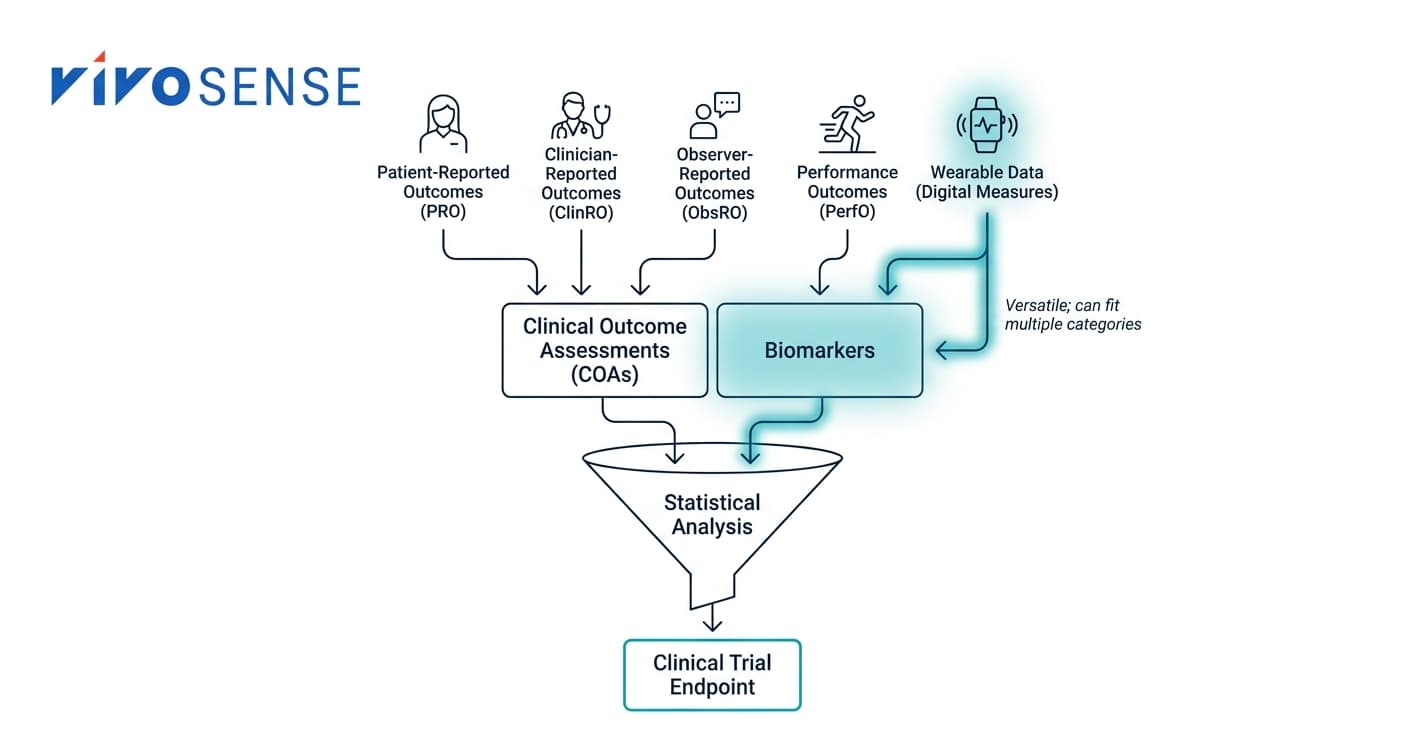
Protocols use biomarkers, clinical outcome assessments and endpoints side by side. In conversation, the terms often blur. A team says “endpoint” when it means a measurement, or “biomarker” when it means a questionnaire score.
Those distinctions matter. They shape what evidence a measure needs, how it is analyzed, and how regulators read it. They matter even more for wearable-derived measures, which can sit in more than one category depending on what they capture.
What Is a Clinical Outcome Assessment?
The U.S. Food and Drug Administration (FDA) states that “a clinical outcome assessment is a measure that describes or reflects how a patient feels, functions, or survives,” in its clinical outcome assessment (COA) frequently asked questions.
The FDA and National Institutes of Health (NIH) Biomarkers, EndpointS, and other Tools (BEST) Resource glossary describes four types of COA, based on who or what provides the information.
Patient-Reported Outcome (PRO)
“A measurement based on a report that comes directly from the patient… about the status of a patient’s health condition without amendment or interpretation of the patient’s response by a clinician or anyone else.” Symptom diaries and quality-of-life questionnaires are common examples.
Clinician-Reported Outcome (ClinRO)
“A measurement based on a report that comes from a trained health-care professional after observation of a patient’s health condition.” A clinician’s rating of disease severity is an example.
Observer-Reported Outcome (ObsRO)
“A measurement based on a report of observable signs, events or behaviors related to a patient’s health condition by someone other than the patient or a health professional.” For example, a parent’s record of a child’s observable behaviors, such as episodes of coughing.
Performance Outcome (PerfO)
“A measurement based on standardized task(s) actively undertaken by a patient according to a set of instructions.” The six-minute walk test (6MWT) is a familiar example.
How Are Clinical Outcome Assessments Selected and Developed?
FDA describes COA selection as starting with the patient’s experience of the disease, not with an existing instrument. Its Patient-Focused Drug Development (PFDD) guidance series sets out that approach in four methodological guidances.
The third, Patient-Focused Drug Development: Selecting, Developing, or Modifying Fit-for-Purpose Clinical Outcome Assessments, was finalized in October 2025. A fourth guidance in the series addresses incorporating COAs into endpoints for regulatory decision-making. Guidance 3 contains nonbinding recommendations.
Guidance 3 describes a roadmap that moves from understanding the disease or condition, to conceptualizing clinical benefits and risks, to selecting or developing the outcome measure. Two terms anchor that roadmap.
Meaningful Aspects of Health
Guidance 3 states that “to provide clinical benefit, a medical product should affect a meaningful aspect of health (MAH), i.e., some aspect of feeling or functioning in daily life that is important to patients.” Identifying MAHs usually draws on direct input from patients and caregivers.
Concept of Interest
The same guidance states: “The concept of interest is what is specifically measured by a COA to help understand how a medical product affects a MAH.” For example, a meaningful aspect of health such as daily activity might lead to a concept of interest such as the ability to walk distances outside the home.
Select, Modify or Develop
With the concept of interest defined, the team first looks for an existing COA that captures it in the target population. If none fits, the team may modify an existing measure or develop a new one, and each route carries its own evidence needs. VivoSense has written about how patient-centric best practice and regulatory guidance for digital measures have developed together.
What Makes a Patient-Reported Outcome Fit for Purpose?
A patient-reported outcome is fit for purpose when sufficient evidence shows it measures the concept of interest well in the intended population and use. The BEST glossary describes fit-for-purpose as a conclusion that “the level of validation associated with a biomarker or COA is sufficient to support its proposed use.”
PFDD Guidance 3 organizes the supporting evidence for any COA, including a PRO, around a set of points a sponsor should be able to argue:
- This type of COA should assess the concept of interest.
- The COA captures all the important parts of the concept of interest.
- The COA is administered appropriately.
- Respondents understand the instructions and items as the measure developer intended.
- The scoring method fits the concept of interest.
- Scores are not overly influenced by concepts outside the concept of interest, or by measurement error.
- Scores correspond to the meaningful aspect of health related to the concept of interest.
A questionnaire developed in one population, language, or mode of administration may need further evidence before it is used in another.
How Is a Biomarker Different From a COA?
The BEST Resource defines a biomarker as “a defined characteristic that is measured as an indicator of normal biological processes, pathogenic processes, or biological responses to an exposure or intervention, including therapeutic interventions.” It adds that “a biomarker is not a measure of how an individual feels, functions, or survives.”
The difference is in what each one describes. A COA describes how a patient feels, functions or survives. A biomarker is a measured characteristic that indicates a biological process or response.
A cholesterol level is a biomarker. A pain questionnaire is a COA. Neither is an endpoint until a trial defines how it will be analyzed. Biomarker categories and the digital version of the term are covered in what digital biomarkers are and how they are validated.
How Do Biomarkers and COAs Become Endpoints?
The BEST Resource defines an endpoint as “a precisely defined variable intended to reflect an outcome of interest that is statistically analyzed to address a particular research question.”
An endpoint takes a measurement, from a biomarker or a COA, and specifies exactly how it will be used: at which time points, how it will be compared, and with what method it will be analyzed. FDA’s final guidance Multiple Endpoints in Clinical Trials (October 2022) groups endpoints for drugs and biological products into primary, secondary, and exploratory families.
Primary Endpoints
A primary endpoint is the main outcome a trial is designed to evaluate. In the guidance’s words, “the endpoint(s) that establish the effect(s) of the drug and will be the basis for concluding that the study meets its objective are designated the primary endpoint family.”
Secondary Endpoints
Secondary endpoints can support the primary result or show a clinical benefit distinct from the effect on the primary endpoint. The guidance explains that positive secondary results can be interpretable if a treatment effect on the primary endpoint family has first been shown.
Exploratory Endpoints
Exploratory endpoints generate information and hypotheses for future research. The guidance notes that “exploratory endpoints do not need multiplicity adjustment because they are generally not used to support conclusions.”
A Hypothetical Example
Consider a hypothetical Phase 3 trial of a treatment for a condition that causes fatigue and limits daily activity. One way the protocol could assign roles:
| Endpoint role | Measure | Type |
|---|---|---|
| Primary | Change from baseline to week 24 in a fatigue questionnaire score | PRO |
| Secondary | Change from baseline to week 24 in 6MWT distance | PerfO |
| Secondary | Clinician global rating of severity at week 24 | ClinRO |
| Exploratory | Change in average daily step count and sleep duration, from a wrist-worn sensor | Digital measures |
Each row names a measurement, a time point and a comparison. The same step count would be a different endpoint if the protocol analyzed it at week 12 or as a proportion of days above a threshold.
Where Do Wearable-Derived Measures Fit?
A measure derived from a wearable sensor is not automatically a biomarker, a COA or an endpoint. Its category depends on what it measures and how the trial uses it.
FDA’s August 2026 paper, Key Considerations for the Development and Use of Digitally Derived Measures for Clinical Investigations, defines digitally derived measures (DDMs) as “measures derived from data collected using DHTs,” where DHTs are digital health technologies. It states that “DDMs may be used as clinical outcome assessments (COAs), biomarkers, or as part of multicomponent endpoints derived from multimodal data.” The paper highlights considerations drawn from existing FDA guidance. It is not guidance itself.
In VivoSense’s own terminology, which uses “digital biomarker” more broadly than the BEST biomarker definition:
- A digital biomarker is an objective, quantifiable physiological or behavioral measurement collected through a digital device. The device can be a wearable sensor, smartphone, or connected health technology.
- A digital endpoint is a trial outcome measure that uses one or more digital biomarkers to assess treatment effects, disease progression, or other study objectives.
Put simply, digital biomarkers are the measurements, while digital endpoints are the outcomes derived from those measurements. The full comparison is in digital biomarkers vs. digital endpoints.
How a particular wearable-derived measure is classified for a given trial is a question for the sponsor’s regulatory strategy, informed by what the measure captures and its intended context of use. The evidence behind the measure is covered in digital measure validation and the V3 framework.
Electronic COAs Are Not the Same as Sensor-Derived Measures
Electronic clinical outcome assessment (eCOA) is the common industry term for COAs collected on an electronic platform instead of paper. Guidance 3 is explicit that the mode does not change the type: “When an electronic mode of administration (e.g., web-based application or an app on a mobile device) is used to collect a PRO, ObsRO, ClinRO, or PerfO, the source of measurement is still considered to be the patient, observer, clinical rater, or standardized task assessment, respectively.”
A symptom diary on a phone is still a PRO. When the source of measurement is the DHT itself, such as a mobile sensor, Guidance 3 points sponsors to FDA’s December 2023 guidance on digital health technologies for remote data acquisition instead.
Sensors Alongside Performance Outcomes
A wearable sensor can also add detail to a PerfO. VivoSense’s July 2026 case study of argenx’s ARGX-119 Phase 1b study in congenital myasthenic syndromes (CMS) describes “DHT-enabled gait analysis during the Six-Minute Walk Test (6MWT),” and reports that “VivoSense analyzed cadence patterns throughout the 6MWT to quantify fatigability.” Read the ARGX-119 digital endpoint strategy case study. How sensors relate to the walk test is covered in the six-minute walk test with wearable sensors.
Terminology at a Glance
| Term | What it is | Example | Common misuse |
|---|---|---|---|
| Biomarker | A measured characteristic indicating a biological process or response | A laboratory value | Calling any measurement a biomarker |
| Clinical outcome assessment | A measure of how a patient feels, functions or survives | A symptom questionnaire | Using it as a synonym for endpoint |
| Patient-reported outcome | A report directly from the patient | A daily symptom diary | Assuming questionnaires are the sole patient-centric option |
| Performance outcome | A standardized task a patient performs | A timed walk test | Assuming it reflects daily life |
| Digital biomarker | An objective measurement collected through a digital device | Daily step count | Calling a raw sensor signal a digital biomarker |
| Endpoint | A defined variable statistically analyzed to answer a research question | Change in a measure from baseline to week 24 | Using it for any measurement in the protocol |
| Primary endpoint | The endpoint that is the basis for concluding a study met its objective | Change in a PRO score at week 24 | Naming more than one without a plan for multiplicity |
| Exploratory endpoint | An endpoint that generates information, generally not used to support conclusions | A digital measure carried for future studies | Treating its results as confirmatory |
Pairing Patient-Reported and Sensor-Derived Measures
Patient-reported outcomes capture what a patient experiences. Sensor-derived measures capture what can be observed continuously in daily life. The two answer different questions, and a study can benefit from collecting both.
VivoSense has published related work. A 2024 paper in the Journal of Patient-Reported Outcomes, a Merck KGaA study in collaboration with VivoSense, examined digital clinical measures (DCMs) in systemic lupus erythematosus (SLE). The study used focus groups with patients living with lupus to identify meaningful aspects of health, including fatigue and energy levels, daily activity limitations and sleep quality, and identified wrist-worn wearable sensors as the preferred way to derive measures of them. Read about the lupus publication.
Planning both kinds of measure starts from the same concept of interest. A fatigue questionnaire and a measure of daily activity can describe the same meaningful aspect of health from two directions, provided the protocol states what each one is for.
Common Mistakes
Using “Biomarker,” “Measure” and “Endpoint” Interchangeably
Each word means something specific. A protocol that mixes them creates confusion for statisticians, sites and regulators.
Assuming a Wearable Measure Is Automatically a Biomarker
A sensor-derived measure may function as a COA, a biomarker or part of a multicomponent endpoint, depending on what it captures.
Treating an Electronic PRO as a Sensor-Derived Measure
A questionnaire answered on a phone is still a PRO. Moving it to an electronic platform does not make it a digital biomarker.
Choosing a Measure Before the Concept of Interest
Start with what matters to patients. The measure follows, and so does the technology. See how to select wearable sensors for a clinical trial.
Assigning Endpoint Roles Too Late
Primary, secondary and exploratory roles belong in the protocol and statistical analysis plan before data collection. Roles assigned after the data are in invite questions about how they were chosen.
Treating Patient-Reported and Sensor-Derived Measures as Competing
They answer different questions. Planning them together gives a fuller picture.
Digital Measures With VivoSense
VivoSense is a wearable sensor contract research organization (CRO) that works alongside the sponsor’s trial team and CRO on the digital measurement workstream. It helps sponsors choose what measures to capture and choose the right device based on the disease state and the population of the patients, ships devices and trains sites, and delivers formatted regulatory-ready data packages for the study team.
VivoSense was founded in 2010.
Frequently Asked Questions
What is a clinical outcome assessment?
A measure that describes or reflects how a patient feels, functions, or survives, according to FDA.
What are the four types of clinical outcome assessments?
Patient-reported outcomes, clinician-reported outcomes, observer-reported outcomes and performance outcomes.
What is a patient-reported outcome?
A measurement based on a report that comes directly from the patient about the status of their health condition, without amendment or interpretation by a clinician or anyone else. Symptom diaries and quality-of-life questionnaires are examples.
What is the difference between a biomarker and a clinical outcome assessment?
A biomarker is a measured characteristic that indicates a biological process or response. A COA describes how a patient feels, functions or survives.
What is the difference between a primary endpoint and a secondary endpoint?
The primary endpoint is the basis for concluding whether a study met its objective. Secondary endpoints support that result or show additional clinical benefit, and their positive results can be interpretable once an effect on the primary endpoint has first been shown.
Is an endpoint the same as a measurement?
No. An endpoint is a precisely defined variable, drawn from a measure, that is statistically analyzed to answer a specific research question.
Can a wearable-derived measure be a clinical outcome assessment?
FDA’s August 2026 paper says digitally derived measures may be used as clinical outcome assessments, biomarkers or parts of multicomponent endpoints. The classification depends on what the measure captures and how it is used.
Is an eCOA a digital biomarker?
No. An electronic COA is a PRO, ObsRO, ClinRO or PerfO collected on an electronic platform, and FDA’s PFDD Guidance 3 treats its source of measurement as unchanged. A digital biomarker is a measurement derived from data a digital device collects.
What is a digital biomarker?
An objective, quantifiable physiological or behavioral measurement collected through a digital device, such as a wearable sensor, smartphone or connected health technology.
Let’s Talk
Schedule a consultation to explore how to design and use validated digital measures in your clinical trials.