

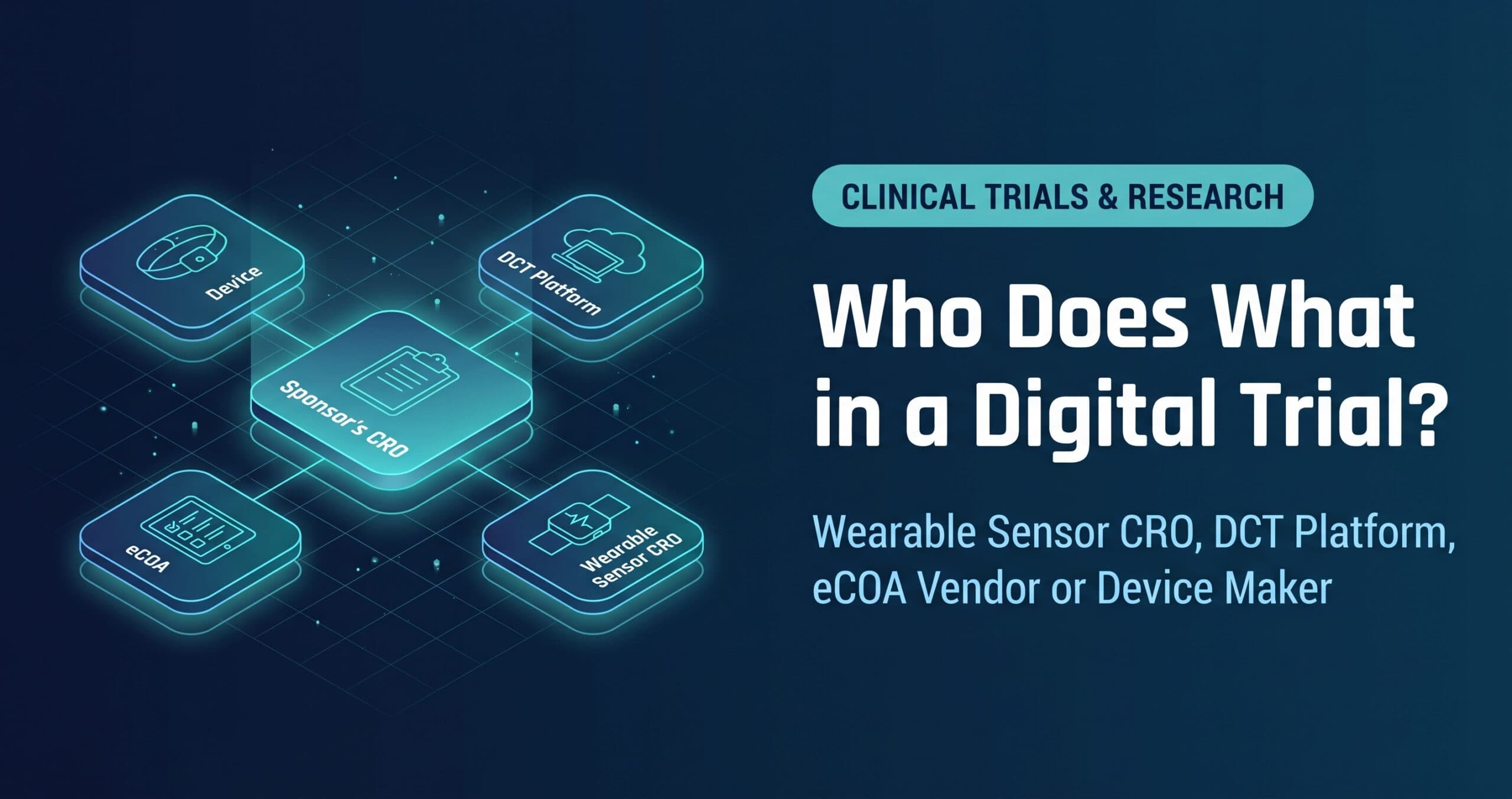
In a digital trial, a device maker builds the sensor, a decentralized clinical trial (DCT) platform runs remote trial workflows, an electronic clinical outcome assessment (eCOA) vendor captures questionnaire-based and other assessments electronically, and a wearable sensor contract research organization (CRO) owns the sensor-based measurement workstream. All of them work alongside the sponsor’s primary CRO.
Sponsors planning a trial with remote elements often meet four kinds of partner in the same month. Their proposals overlap on the surface, and each one can sound like it covers the whole digital side of the study. This article explains what each partner typically does, where the gaps between them appear, and how to decide which ones a study needs.
Who Are the Partners in a Digital Clinical Trial?
A trial with wearable sensors and remote elements usually involves some combination of five parties:
- The sponsor’s primary CRO, which manages the overall trial
- A DCT platform, which supports remote trial activities
- An eCOA vendor, which captures clinical outcome assessments electronically
- One or more device makers, which build the sensors
- A wearable sensor CRO, which designs, deploys and analyzes the sensor-based measures
Not every study needs all five. The point is to know which job each one is there to do.
What Does a Decentralized Clinical Trial Platform Do?
A decentralized clinical trial platform is software that supports trial activities taking place away from the site. Depending on the vendor, that can include electronic consent, telehealth visits, scheduling, participant communication and direct-to-participant logistics. Many platforms can also receive data from connected devices.
The U.S. Food and Drug Administration (FDA) describes decentralized elements as trial activities that occur remotely, such as telehealth visits, in-home visits with remote trial personnel or visits with local health care providers. Its guidance on conducting clinical trials with decentralized elements, finalized in September 2024, recommends a data management plan that describes where data originates and how it flows to the sponsor.
A DCT platform moves data and coordinates activity. It does not usually decide which sensor-based measure fits the clinical question, or build the evidence that a measure is fit for purpose.
What Does an eCOA Vendor Do?
Clinical outcome assessments describe how a patient feels, functions or survives. They include patient-reported outcomes (PROs), clinician-reported outcomes (ClinROs), observer-reported outcomes (ObsROs) and performance outcomes (PerfOs). An eCOA vendor provides the electronic systems that capture these assessments, often on a tablet or the participant’s smartphone. Electronic patient-reported outcomes (ePROs) are the most familiar example.
eCOA systems are built around instruments and questionnaires. Sensor-based measures, such as daily step count from a wrist-worn accelerometer, are collected passively and processed differently. The two often sit side by side in the same protocol.
What Does a Wearable Device Maker Do?
A device maker designs and manufactures the sensor, maintains its firmware and software, and supplies the device and its data output. Device makers know their own hardware in depth.
A single device maker’s view is limited to its own products. The questions of which device suits a given disease state and patient population, and how its output becomes a trial measure, usually sit with someone else.
What Does a Wearable Sensor CRO Do?
A wearable sensor CRO is “a contract research organization that specializes in the selection, deployment, validation, analysis, and interpretation of wearable sensor technologies and digital measures in clinical research.” Rather than replacing a traditional CRO, it works alongside the sponsor’s existing trial partners.
Its job is the digital measurement workstream. Starting from the clinical question, that typically covers deciding which measures to capture, choosing the right device for the disease state and patient population, shipping devices, training sites, monitoring wear compliance during the study, and turning data from multiple sensors into analysis-ready measures. For more, read What Is a Wearable Sensor CRO?
How Do These Roles Compare?
| Partner | Core job | Typical output | Usually outside its scope |
|---|---|---|---|
| Sponsor’s primary CRO | Manages the overall trial | Site management, monitoring, trial data | Sensor-based measure design and analysis |
| DCT platform | Runs remote trial workflows | Remote visits, consent, logistics, data flow | Choosing and justifying sensor-based measures |
| eCOA vendor | Captures clinical outcome assessments electronically | PRO, ClinRO, ObsRO and PerfO data | Passive sensor data processing |
| Device maker | Builds and supports the sensor | Device, firmware, raw data output | Measure selection across devices and populations |
| Wearable sensor CRO | Owns the sensor-based measurement workstream | Analysis-ready digital measures | Overall trial management |
Actual scope varies by vendor. Use the table as a starting point for questions, not as a description of any one company.
Where Do Gaps Appear Between These Partners?
Most problems in digital trials happen at the handoffs, where each partner assumes another one owns the task.
- Nobody owns the concept of interest. The device is chosen and the platform is configured before anyone has defined what the measure should show.
- Wear compliance is visible to no one. Data flows through the platform, but no one is monitoring wear against the protocol while the study runs.
- Raw data arrives, but no measure. The sponsor receives device files, not a digital biomarker with documented processing.
- Formats do not line up. Two sensors and an eCOA system produce three data structures with different timestamps.
- Training is fragmented. Sites receive separate instructions from each vendor, and none covers the full participant experience.
FDA guidance on digital health technologies for remote data acquisition, finalized in December 2023, recommends that sponsors describe how data is collected, stored, transmitted and archived. That is easier when one partner owns the digital measurement workstream.
How Should a Sponsor Decide Which Partners It Needs?
Start with the measures, not the vendors. These questions help:
- What clinical concept does the trial need to measure, and is a sensor-based measure the right fit?
- Which assessments are questionnaire-based, and which are passive sensor data?
- Who will select the device and justify it for this population?
- Who will monitor wear compliance during the study, and who acts on low wear?
- Who will combine data from different sensors and systems into one analysis-ready dataset?
- How will each partner’s responsibilities be written into contracts and the data management plan?
If the answer to several of these is “no one yet,” the study has a gap in the digital measurement workstream. Our guide on how to evaluate a digital endpoint partner covers what to look for.
How Does VivoSense Fit Alongside Your Trial Partners?
VivoSense is a wearable sensor CRO. It does not manufacture devices and it does not replace the sponsor’s CRO. It covers the digital measurement workstream end to end, working alongside the sponsor’s CRO and other trial partners.
Starting from the sponsor’s clinical question, VivoSense helps the sponsor choose the right device based on the disease state and the population of the patients, works with the study team on which measures to capture, ships devices and trains sites. A purpose-built cloud platform monitors devices getting to site and onto participants, and tracks wear compliance in real time. Data from multiple sensors is ingested, cleaned and run through VivoSense algorithms to produce formatted, regulatory-ready data packages for the study team. See Our Solutions for more.
Frequently Asked Questions
What is a decentralized clinical trial platform?
A decentralized clinical trial platform is software that supports trial activities away from the site, such as electronic consent, telehealth visits, scheduling and direct-to-participant logistics. Many platforms can also receive data from connected devices.
What is the difference between a DCT platform and a wearable sensor CRO?
A DCT platform runs remote trial workflows and moves data. A wearable sensor CRO designs, deploys and analyzes the sensor-based measures, working alongside the sponsor’s CRO.
What is the difference between eCOA and sensor-based measures?
eCOA systems capture clinical outcome assessments, such as patient-reported outcomes, electronically. Sensor-based measures are collected passively by a wearable device and processed into digital biomarkers.
Does a wearable sensor CRO replace the sponsor’s CRO?
No. A wearable sensor CRO works alongside the sponsor’s CRO and covers the digital measurement workstream only.
Who selects the wearable device in a digital trial?
That depends on how responsibilities are assigned. A wearable sensor CRO typically helps the sponsor choose a device based on the disease state and the patient population, rather than defaulting to a single manufacturer’s products.
Which companies provide remote monitoring for decentralized studies?
Remote monitoring spans several types of partners. DCT platforms coordinate remote activities, eCOA vendors capture assessments, device makers supply sensors, and wearable sensor CROs manage sensor-based measures and wear compliance. Most studies combine more than one.
Let’s Talk
Schedule a consultation to explore designing and using validated digital measures in your clinical trials.